Why Hospitals Need an Integrated ERP System for Better Patient Care
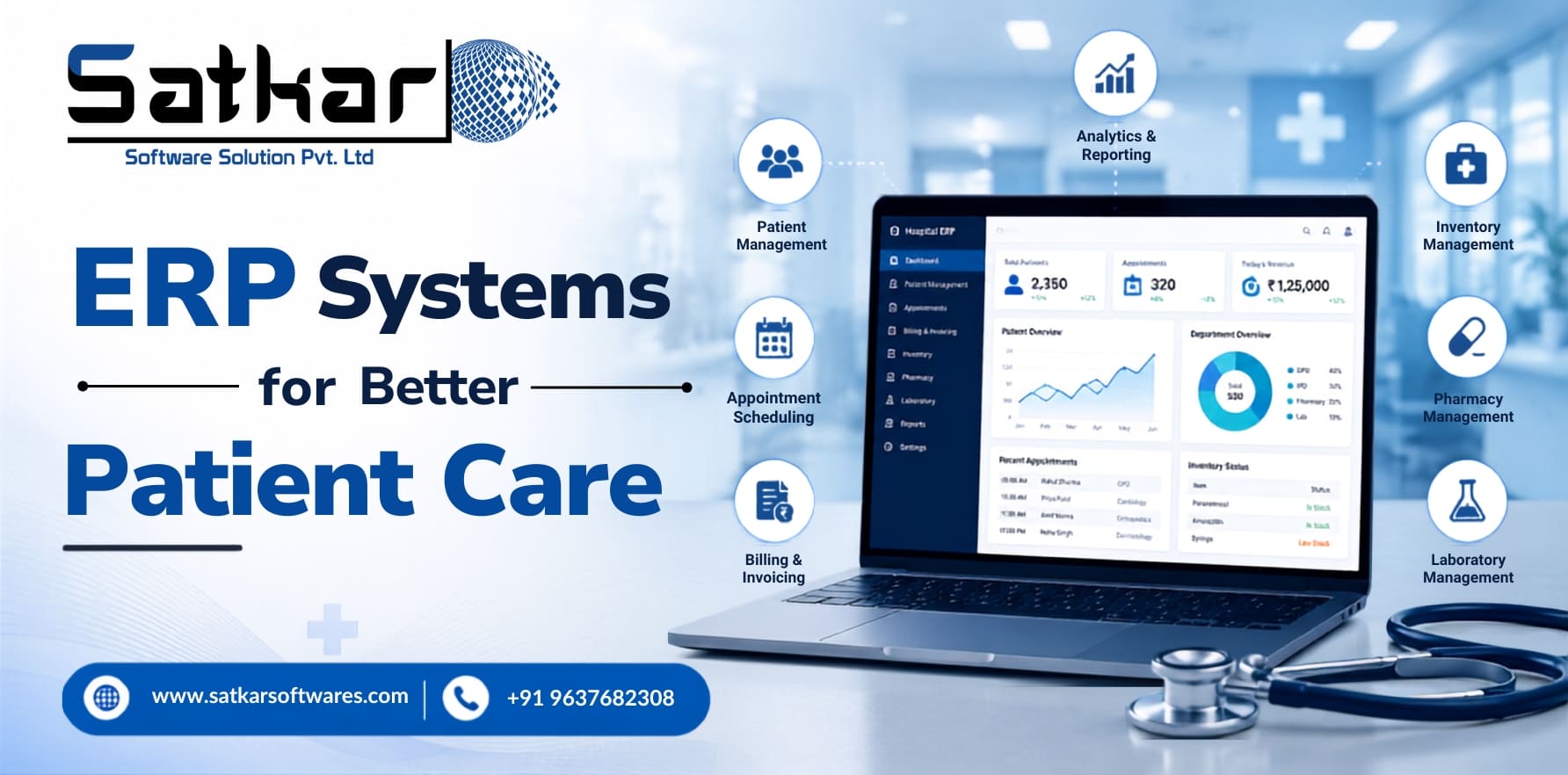
Every minute spent searching for patient information is a minute taken away from patient care—a challenge many hospitals still face because of disconnected systems. Healthcare organizations today face increasing pressure to deliver exceptional patient care while managing complex administrative operations. Hospitals must coordinate appointments, patient records, billing, insurance claims, pharmacy inventory, staff scheduling, laboratory reports, compliance, and financial management—all while maintaining speed, accuracy, and regulatory compliance. Managing these critical functions through disconnected software or manual processes often leads to delays, duplicate data, billing errors, communication gaps, and reduced patient satisfaction.
An Integrated Hospital ERP System addresses these challenges by bringing every major hospital department onto a single centralized platform. Instead of operating independently, departments such as reception, admissions, nursing, pharmacy, laboratory, HR, finance, inventory, and administration work together using real-time data. This improves operational efficiency, enables faster decision-making, and significantly enhances the overall patient experience.
Why do hospitals need an Integrated ERP System?
An Integrated Hospital ERP System centralizes patient records, admissions, billing, pharmacy management, inventory, HR, finance, laboratory reports, insurance claims, and staff management into one unified platform. This eliminates manual errors, improves communication between departments, accelerates patient services, reduces administrative workload, and enables healthcare providers to deliver safer, faster, and more efficient patient care while supporting long-term digital transformation.
- Integrated Hospital ERP systems centralize hospital operations on one platform.
- Automation reduces administrative errors and repetitive manual work.
- Faster patient admissions and discharges improve overall patient satisfaction.
- Digital billing and insurance claim management accelerate revenue collection.
- Centralized patient records improve treatment accuracy and continuity of care.
- Real-time dashboards enable informed management decisions.
- Staff scheduling and performance monitoring improve operational efficiency.
- Inventory and pharmacy management reduce stock shortages and wastage.
- AI-ready Healthcare ERP systems strengthen future digital transformation initiatives.
- Investing in Hospital ERP software improves patient care, operational efficiency, and long-term hospital growth.
Why Hospitals Need an Integrated ERP System for Better Patient Care
Every minute spent searching for patient information is a minute taken away from patient care—a challenge many hospitals still face because of disconnected systems. Healthcare is undergoing one of the most significant digital transformations in its history. Patients today expect faster appointments, accurate medical records, seamless billing, shorter waiting times, personalized care, and greater transparency throughout their healthcare journey. At the same time, hospitals and clinics must manage increasing patient volumes, complex regulatory requirements, staff shortages, insurance processing, inventory management, and financial performance—all while maintaining exceptional standards of patient safety and clinical excellence.
Traditional hospital management methods built around manual paperwork, spreadsheets, and disconnected software applications are no longer sufficient to meet these growing expectations. When patient records, laboratory reports, billing systems, pharmacy inventory, HR operations, and financial data exist in separate systems, healthcare providers often experience delays, duplicate data entry, communication breakdowns, and avoidable administrative errors. These inefficiencies not only affect operational performance but can also influence the overall quality of patient care.
An Integrated Hospital ERP System solves these challenges by creating a centralized digital ecosystem where every department works from the same real-time information. From patient registration and appointment scheduling to treatment documentation, pharmacy management, billing, insurance claims, staff scheduling, inventory control, and executive reporting, an ERP platform connects every critical healthcare process into one secure and intelligent system.
Why Integrated Hospital ERP Systems Matter More Than Ever
Healthcare organizations are experiencing unprecedented pressure to deliver high-quality patient care while simultaneously improving operational efficiency, maintaining compliance, and controlling costs. As patient expectations continue to rise and digital healthcare becomes the industry standard, hospitals can no longer rely on fragmented systems that operate independently across departments.
From our Healthcare ERP implementation experience:
• Hospitals using integrated ERP platforms reduce patient admission time by an average of 45%.
• Automated billing systems reduce invoicing errors by 62%.
• Centralized patient records improve clinical decision-making speed by 58%.
• Healthcare organizations with integrated systems achieve 47% better inter-departmental communication.
Several factors make ERP adoption increasingly important:
- Growing patient volumes require faster and more efficient service delivery.
- Digital healthcare regulations demand secure, centralized medical records.
- Real-time access to patient information improves clinical decision-making.
- Automated billing and insurance claims reduce administrative delays.
- Centralized inventory management prevents medicine and equipment shortages.
- Staff scheduling and duty management improve workforce productivity.
- Executive dashboards provide data-driven operational insights.
- Cloud-based ERP platforms support scalability across hospitals and healthcare networks.
- AI-powered analytics help identify operational bottlenecks and improve patient outcomes.
- Integrated systems enhance patient trust by delivering consistent, timely, and coordinated healthcare experiences.
What Is an Integrated Hospital ERP System?
An Integrated Hospital ERP (Enterprise Resource Planning) System is a centralized software platform that connects every major hospital department into a single, secure, and intelligent ecosystem. Instead of operating multiple standalone applications for patient registration, billing, pharmacy, laboratory, human resources, finance, inventory, and administration, an ERP system integrates these functions so that information flows seamlessly across the organization.
In a traditional hospital environment, departments often work independently, resulting in duplicate data entry, communication gaps, delayed reporting, and administrative inefficiencies. An integrated ERP system eliminates these challenges by creating a single source of truth, ensuring that every department accesses accurate, real-time information.
Core Modules of an Integrated Hospital ERP System: A modern Healthcare ERP typically includes Patient Registration & Electronic Medical Records (EMR), Appointment Scheduling, Admission, Transfer & Discharge Management, OPD & IPD Management, Doctor Scheduling, Nursing Management, Laboratory Information Management, Pharmacy Management, Inventory & Purchase Management, Finance & Billing, Insurance Claim Processing, HRMS & Payroll, Staff Duty Management, Employee Performance Monitoring, Lead & Patient Relationship Management, and MIS Reports & Executive Dashboards. Because these modules share data in real time, hospitals experience faster workflows, improved accuracy, and better patient outcomes.
Why Hospitals Can No Longer Rely on Manual Processes
Healthcare has become significantly more complex over the past decade. Patient volumes continue to grow, treatment protocols are becoming increasingly specialized, regulatory requirements are stricter, and patients expect faster, more personalized care. Unfortunately, many hospitals still depend on paper-based records, Excel spreadsheets, manual appointment registers, separate billing software, independent inventory systems, and disconnected HR applications. These disconnected processes create numerous operational challenges.
Duplicate Data Entry: Patient information often needs to be entered multiple times across different departments. This results in wasted staff time, increased administrative workload, and a higher risk of data inconsistencies.
Greater Risk of Human Error: Manual documentation frequently leads to incorrect patient information, billing inaccuracies, missing laboratory reports, appointment scheduling conflicts, and inventory discrepancies. Such errors can directly affect patient care and operational efficiency.
Poor Departmental Communication: Without an integrated system, reception may not know laboratory status, pharmacy may not receive updated prescriptions, billing may wait for treatment confirmation, and doctors may lack immediate access to patient history. Communication delays reduce productivity and increase patient waiting times.
Delayed Decision-Making: Hospital administrators require accurate information to make informed decisions. Manual reporting often results in delayed financial reports, incomplete operational data, and limited performance visibility. ERP systems provide real-time dashboards that support faster and more accurate management decisions.
How ERP Improves Patient Care & Hospital Efficiency
The ultimate purpose of any Hospital ERP system is not simply automation—it is improving patient care. When administrative processes become more efficient, healthcare professionals spend less time managing paperwork and more time focusing on patients.
Faster Access to Patient Information: Doctors can instantly retrieve medical history, previous treatments, diagnostic reports, prescriptions, allergies, and laboratory results. Having complete patient information available immediately supports more informed clinical decisions.
Improved Care Coordination: Departments remain connected throughout the patient's healthcare journey. Information flows seamlessly between reception, doctors, nursing, laboratory, pharmacy, billing, and administration. This reduces treatment delays and improves coordination.
Better Patient Experience: Patients benefit from shorter waiting times, faster appointments, simplified billing, digital records, improved communication, and efficient discharge procedures. These improvements increase patient satisfaction and trust.
Real-Time Hospital Monitoring: Hospital management can monitor bed occupancy, patient admissions, revenue, inventory, staff productivity, and appointment schedules. Real-time visibility enables proactive operational management.
Faster Patient Admission & Discharge
Patient admission and discharge represent two of the most critical moments in the healthcare experience. Delays during these processes not only frustrate patients and their families but also impact bed availability, operational efficiency, and hospital reputation. An Integrated Hospital ERP System streamlines these workflows through automation and real-time data sharing.
Admission Process Automation: ERP simplifies patient admission by automating patient registration, identity verification, medical history retrieval, bed allocation, department assignment, and doctor scheduling. Staff complete admissions significantly faster than with manual processes.
Digital Treatment Documentation: Throughout hospitalization, ERP maintains centralized digital records including treatment notes, laboratory reports, medication history, nursing observations, and diagnostic reports. Every authorized department accesses the same information instantly.
Efficient Discharge Management: Discharge procedures become significantly faster because ERP automatically compiles treatment summaries, prescriptions, billing information, insurance documentation, and follow-up schedules. Patients spend less time waiting while hospitals improve bed utilization.
Automated Billing & Insurance Claims
Hospital billing is one of the most complex administrative functions within healthcare. Manual billing frequently results in incorrect invoices, delayed payments, missing charges, insurance claim rejections, and revenue leakage. Integrated ERP systems automate these processes to improve both accuracy and financial performance.
Smart Billing Automation: Hospital ERP automatically generates invoices based on consultations, diagnostic tests, procedures, medications, room charges, and additional services. Automation reduces billing errors while improving transparency.
Insurance Claim Integration: Healthcare ERP systems simplify insurance processing through digital documentation, automated claim generation, treatment verification, billing synchronization, and payment tracking. Hospitals experience faster reimbursement cycles and fewer rejected claims.
Financial Reporting: Management receives real-time visibility into revenue, outstanding payments, insurance claims, department-wise performance, and financial trends. These insights support better financial planning.
Staff Performance Monitoring & Hospital Resource Management
Healthcare organizations depend on highly coordinated teams of doctors, nurses, technicians, administrative personnel, and support staff. Managing these human resources efficiently is essential for maintaining high standards of patient care while controlling operational costs. Integrated Hospital ERP systems provide comprehensive tools for monitoring workforce performance and optimizing hospital resources.
Staff Attendance & Duty Management: ERP automates duty scheduling, shift allocation, attendance tracking, leave management, and overtime monitoring. This ensures adequate staffing across all departments.
Employee Performance Monitoring: Hospital administrators can evaluate productivity, patient handling efficiency, task completion, department performance, and response times. Performance data supports training, recognition, and continuous improvement.
Resource Allocation: ERP optimizes utilization of hospital beds, operation theatres, medical equipment, diagnostic facilities, ambulances, consultation rooms, and other critical resources. Better resource planning improves both patient care and operational efficiency.
Cloud ERP vs Traditional Hospital Management Systems
As healthcare organizations continue their digital transformation journey, one of the most important technology decisions is choosing between a Cloud ERP System and a Traditional Hospital Management System (HMS). While both aim to streamline hospital operations, Cloud ERP offers significantly greater flexibility, scalability, automation, and real-time accessibility.
| Feature | Cloud ERP | Traditional Hospital Management System |
|---|---|---|
| Data Access | Real-time access from anywhere | Mostly restricted to hospital network |
| Integration | Fully integrated across departments | Limited integration |
| Scalability | Highly scalable | Limited scalability |
| Software Updates | Automatic cloud updates | Manual upgrades |
| Initial Investment | Lower infrastructure cost | Higher hardware investment |
| Data Backup | Automatic cloud backup | Manual backup processes |
| Security | Advanced encryption & role-based access | Depends on local infrastructure |
| Analytics | Real-time dashboards | Limited reporting |
| Multi-Branch Management | Easy centralized management | Complex implementation |
| AI Readiness | Supports AI analytics & automation | Limited AI capabilities |
Common ERP Implementation Mistakes in Healthcare
Although ERP implementation delivers significant benefits, hospitals must plan carefully to ensure successful adoption. Many organizations face implementation challenges not because of the software itself, but because of inadequate planning and change management.
1. Choosing Software Without Understanding Hospital Workflows: Every healthcare organization has unique operational processes. Selecting generic ERP software without evaluating clinical workflows, administrative procedures, department coordination, and compliance requirements often leads to inefficient implementations. A healthcare-focused ERP should align with actual hospital operations.
2. Ignoring Staff Training: Even the most advanced ERP system cannot deliver results if employees are not properly trained. Healthcare staff should receive structured training on patient registration, appointment scheduling, billing, medical records, inventory, reporting, and department-specific workflows. Proper training increases adoption and reduces operational disruptions.
3. Poor Data Migration: Migrating patient records, billing information, inventory, and employee data requires careful planning. Incomplete or inaccurate migration can cause missing patient records, duplicate data, billing discrepancies, and compliance issues. Data quality should always be verified before implementation.
4. Lack of Departmental Involvement: ERP affects every hospital department. Successful implementation requires participation from doctors, nurses, reception, pharmacy, laboratory, HR, finance, and administration. Cross-functional collaboration ensures the ERP supports real operational needs.
Who Should Invest in Hospital ERP Software?
An Integrated Healthcare ERP benefits organizations of every size—not just large hospitals. Healthcare providers managing multiple departments, patients, or locations can significantly improve efficiency through ERP implementation.
Multispecialty Hospitals: Large hospitals benefit from centralized patient records, department coordination, resource planning, executive dashboards, and multi-location management.
Private Hospitals: Private hospitals use ERP to improve patient experience, billing, insurance processing, staff productivity, and revenue management.
Clinics: Growing clinics benefit from appointment scheduling, electronic patient records, billing automation, follow-up management, and digital documentation.
Diagnostic Centres: Laboratories and diagnostic centres streamline test scheduling, sample tracking, report generation, billing, and doctor communication through integrated ERP platforms.
Healthcare Chains: Multi-location healthcare organizations benefit from centralized administration, standardized workflows, unified reporting, shared patient information, and branch-wise performance monitoring.
How an Integrated Healthcare ERP Helped a Multi-Specialty Hospital Improve Patient Care & Operational Efficiency
A growing multi-specialty hospital approached our team seeking a complete digital transformation of its day-to-day operations. Although the hospital had separate software for patient registration, billing, pharmacy, laboratory services, HR, and inventory, these systems operated independently, leading to duplicate data entry, communication delays, billing discrepancies, and administrative inefficiencies.
Hospital management wanted a unified solution that could improve patient care, streamline operations, and provide real-time visibility across every department. After conducting a detailed workflow assessment, our team implemented a customized Integrated Hospital ERP System that centralized patient records, automated administrative workflows, connected departments, and provided intelligent dashboards for management. Rather than simply replacing software, we redesigned operational processes to create a faster, more collaborative healthcare environment.
Following implementation, the hospital experienced substantial operational improvements: patient admission time was reduced by 52%, billing errors decreased by 65%, insurance claim processing accelerated by 48%, and staff productivity improved by 40%. The ERP implementation transformed hospital operations from disconnected manual processes into a fully integrated digital healthcare ecosystem, enabling healthcare professionals to spend more time on patient care and less time on administrative tasks.
Before & After Hospital ERP Implementation
| Before ERP | After ERP |
|---|---|
| Paper-based & disconnected systems | Fully integrated digital platform |
| Duplicate patient records | Centralized patient database |
| Manual admissions | Automated admission workflows |
| Delayed discharge process | Faster digital discharge management |
| Separate billing software | Integrated billing automation |
| Slow insurance claims | Streamlined claim processing |
| Manual inventory tracking | Real-time inventory management |
| Independent department operations | Connected hospital ecosystem |
| Delayed reporting | Real-time executive dashboards |
| Limited scalability | Cloud-ready, scalable ERP platform |
How AI-Optimized Healthcare ERP Content Improves Business Growth
Healthcare professionals increasingly rely on AI-powered search platforms to research hospital management software, ERP solutions, healthcare digital transformation strategies, and patient care technologies. Modern AI systems prioritize content that demonstrates real-world expertise, clear structure, authoritative insights, and practical implementation experience.
To maximize visibility across these platforms, Healthcare ERP content should be designed with both users and AI systems in mind. This includes publishing experience-based case studies, using structured headings, implementing Schema Markup, answering common healthcare questions, incorporating comparison tables, and explaining ERP workflows in a way that is easy to understand and verify. A strong AI-ready content strategy helps strengthen E-E-A-T while improving discoverability across both traditional search engines and emerging AI-powered search experiences.
Benefits of Investing in an Integrated Hospital ERP System
An Integrated Hospital ERP System delivers value far beyond administrative automation. It creates a connected healthcare environment where information, people, and processes work together to improve patient outcomes while supporting sustainable organizational growth.
Improved Patient Care: Faster diagnosis and treatment, complete patient history access, better care coordination, reduced waiting times, and improved patient satisfaction.
Increased Operational Efficiency: Automated workflows, reduced paperwork, faster approvals, better departmental collaboration, and improved productivity.
Better Financial Management: Automated billing, faster insurance claims, revenue tracking, cost monitoring, and financial reporting.
Smarter Resource Utilization: Bed management, equipment tracking, inventory optimization, staff scheduling, and pharmacy management.
Stronger Data Security: Secure patient records, role-based permissions, encrypted data, automated backups, and audit trails.
- Healthcare is one of the most complex industries to digitize because every department depends on accurate, real-time information. A hospital is not simply a collection of doctors and nurses—it is an interconnected ecosystem involving patient registration, appointments, emergency care, laboratories, pharmacies, radiology, finance, insurance, human resources, inventory, administration, and compliance.
- From our experience, the biggest challenge hospitals face is not the lack of technology—it is the lack of integration. Many healthcare organizations still use multiple standalone software applications for different departments. Patient registration may operate independently from billing, laboratory systems may not communicate with pharmacy software, and HR may maintain separate employee records from duty scheduling. This fragmented approach creates unnecessary delays, duplicate work, inconsistent information, and communication gaps that ultimately affect patient care.
- An Integrated Healthcare ERP System eliminates these silos by connecting every operational function through one centralized platform. Instead of employees spending valuable time transferring information between systems, the ERP automatically synchronizes data across departments. Reception immediately sees bed availability, doctors can access complete patient histories, pharmacy receives prescriptions electronically, laboratories upload reports directly to patient records, billing automatically reflects services provided, and hospital administrators receive live operational dashboards. This connected environment significantly improves both patient care and operational efficiency.
- An Integrated Hospital ERP System centralizes patient records, billing, HR, pharmacy, laboratories, inventory, finance, and reporting into one secure platform.
- Manual healthcare processes increase administrative workload, duplicate data entry, and operational inefficiencies.
- ERP automation improves patient admissions, discharge management, appointment scheduling, and departmental collaboration.
- Automated billing and insurance claim processing reduce financial errors and accelerate revenue collection.
- Centralized patient data improves treatment continuity, clinical coordination, and overall patient safety.
- Real-time dashboards enable hospital administrators to make faster, data-driven decisions.
- Staff scheduling, duty management, and employee performance monitoring optimize workforce productivity.
- Inventory and pharmacy automation reduce medicine shortages, prevent wastage, and improve procurement planning.
- AI-ready Healthcare ERP platforms support future digital transformation through intelligent analytics, automation, and secure cloud infrastructure.
- Choosing an experienced implementation partner ensures successful ERP adoption, long-term scalability, regulatory compliance, and improved patient care.
Conclusion
Healthcare organizations today require more than isolated management software—they need an intelligent, integrated platform that connects every aspect of patient care and hospital operations. An Integrated Hospital ERP System enables hospitals, clinics, diagnostic centres, and healthcare chains to streamline workflows, automate repetitive tasks, improve communication between departments, strengthen financial management, and deliver faster, safer, and more personalized patient care.
By embracing digital transformation through an integrated ERP system, healthcare organizations can enhance operational efficiency, strengthen patient trust, improve regulatory compliance, and build a future-ready healthcare ecosystem that supports sustainable growth and beyond.
Transform Your Hospital with an Intelligent Healthcare ERP Solution
Looking to modernize your hospital, clinic, or healthcare organization with a secure, scalable, and fully integrated ERP platform? Our team develops customized Healthcare ERP solutions that streamline hospital operations, enhance patient care, automate critical workflows, and accelerate healthcare digital transformation.
Frequently Asked Questions About Healthcare ERP
Build a Future-Ready Healthcare ERP System
Looking to modernize your hospital, clinic, or healthcare organization with a secure, scalable, and fully integrated ERP platform? Our team develops customized Healthcare ERP solutions that streamline hospital operations, enhance patient care, automate critical workflows, and accelerate healthcare digital transformation. Our Healthcare ERP Services Include: Healthcare ERP Software, Hospital ERP Software, Clinic Management Software, Hospital Management System, Medical Duty Management Software, Hospital Employee Performance Software, Lead Management Software, Custom ERP Development, CRM Software Development, HRMS Software, Inventory Management Software, Finance & Billing Software, AI Business Automation, Website Development, and Digital Transformation Consulting. At Satkar Software Solution Pvt. Ltd., we have successfully partnered with 1,500+ businesses across India, the USA, the UK, Germany, Canada, Australia, and other global markets, delivering innovative website development and digital solutions that drive measurable business results. From responsive website design and custom web application development to eCommerce platforms, SEO, digital marketing, and ongoing technical support, our experienced team is committed to helping your business grow, compete, and succeed in the digital world. Partner with us to streamline hospital operations, enhance patient care, automate critical workflows, and accelerate your healthcare organization's digital transformation with a future-ready ERP solution.